
Far-infrared clothing and Celliant: what the evidence says
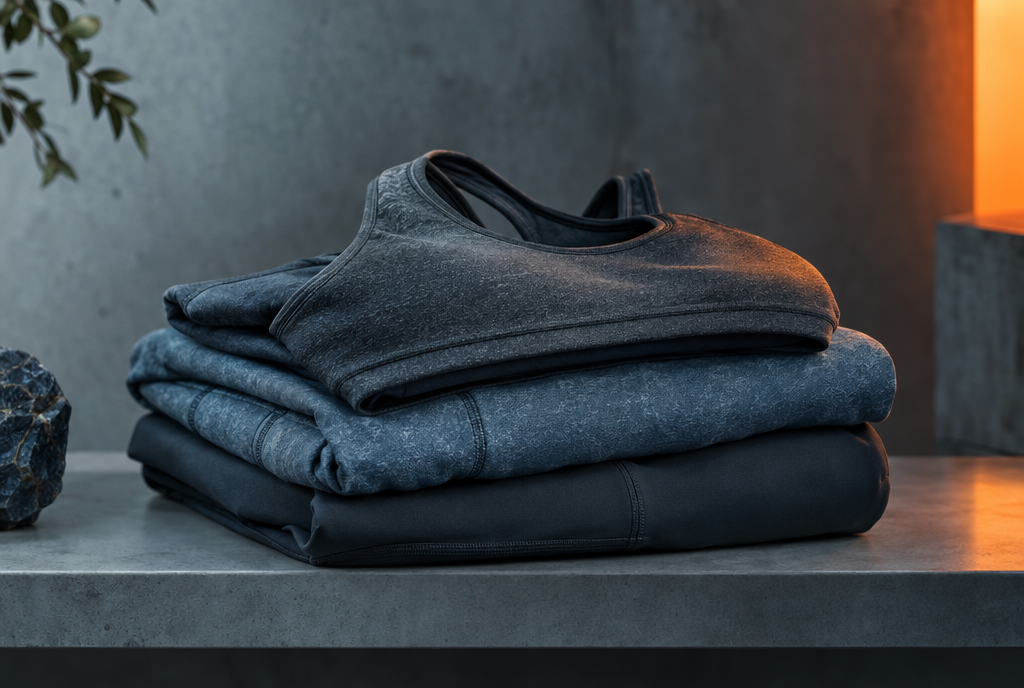
Far-infrared (FIR) clothing contains mineral particles that absorb body heat and re-emit part of it as infrared energy. Physics allows a small effect on how heat moves, but a passive fabric cannot create energy. Controlled studies are few, small and mixed: some report modest changes in recovery or fatigue measures, and none show large warmth or health benefits. Read bold claims with caution.
What is far-infrared clothing?
FIR clothing, sometimes called infrared-emitting or bioceramic apparel, has fine mineral or ceramic particles embedded in its fibers. Manufacturers say these particles absorb heat from the body and re-emit it as far-infrared energy toward the skin.
Definitions of the far-infrared band vary between fields. A 2021 systematic review in PLOS One describes it as a band from 50 to 1000 micrometers, while other sources draw the boundaries differently. What matters for clothing is simpler: every warm object, including your skin and your shirt, already emits infrared energy.
How is FIR clothing supposed to work, and what does physics allow?
Your body loses much of its heat as infrared radiation. At rest, OpenAnesthesia puts radiation at about 60% of total heat loss. Any fabric absorbs some of that radiation and re-emits some of it, both outward and back toward the skin.
Changing the minerals in a fiber can change how strongly the fabric absorbs and emits at particular wavelengths. That can shift how heat moves near the skin, but only by rearranging energy the body already produced. A passive textile cannot add energy the way a warmer or battery heater does, so any warming effect is bounded by the heat you supply.
This is why FIR claims should be judged on measured outcomes, not on descriptions of mechanisms. Reviews of far-infrared biology, such as the widely cited 2012 overview by Vatansever and Hamblin, discuss proposed mechanisms, but proposed mechanisms are not the same as demonstrated results for an everyday garment.
What do the studies show?
The best summary for sports use is the PLOS One systematic review of FIR-emitting garments. It found eleven eligible studies, six during exercise and five during recovery. Studies were scarce and results inconclusive; sample sizes ranged from 5 to 22 participants, and designs varied too much for meta-analysis.
During exercise, results on oxygen use and performance were mixed. For recovery, the authors reported small to large effect sizes suggesting faster recovery of some indirect markers of muscle damage, including delayed-onset muscle soreness, while direct measures of muscle function did not change. They recommended keeping a cautious approach.
Sleep is the other common claim. A 2023 pilot randomized, double-blind, sham-controlled trial gave 40 poor sleepers FIR-emitting or sham pajamas for six weeks. Both groups improved, with no significant between-group difference in sleep quality. The FIR group did better on a physical fatigue score. The authors listed limitations including small size, no objective sleep measures, a mostly female sample and sham pajamas that did not successfully mask group allocation.
| Claim | What studies found | Strength of evidence |
|---|---|---|
| Better athletic performance | Mixed, mostly no significant effect | Low: few small studies |
| Faster recovery | Some indirect markers improved; muscle function unchanged | Low to moderate: small studies |
| Better sleep quality | No significant difference vs sham in a pilot trial | Low: one small pilot |
| More warmth | Bounded by body heat; no large effect shown | Low for large claims |
What did the FDA say about Celliant?
Celliant, made by Hologenix, is the best-known FIR textile ingredient. In 2017 the FDA issued a determination, in response to a company request, that Celliant products are medical devices under the Federal Food, Drug and Cosmetic Act and are general wellness products.
Celliant states plainly that this determination is not an FDA clearance or approval. According to the company, the determination concerns wellness claims such as temporarily increasing local blood flow in healthy people. A regulatory classification describes what a company may say and how a product is regulated; it is not the same as independent evidence that a product works.
Are there side effects of far-infrared clothing?
Passive FIR fabrics work at body temperature and emit the same kind of infrared energy as ordinary clothing, so they are not expected to cause the risks associated with high-power infrared lamps. The practical concerns are cost, unproven benefit and skin sensitivity to any new fabric.
Do not use FIR clothing as a substitute for care. If you have pain, poor sleep, cold sensitivity or circulation symptoms, talk to a clinician about what is causing them.
How to evaluate FIR claims before you buy
A few questions separate careful claims from marketing.
Was the product tested against a sham or ordinary fabric, with people who did not know which they wore?
How many participants, and were results published in a peer-reviewed journal?
Does the claim describe a measured outcome, such as comfort or skin temperature, or only a mechanism?
Is a regulatory status described accurately, without implying clearance or approval?
For warmth, would insulation, a reflective layer or a heat source address the need more directly?
Key takeaways
FIR clothing embeds minerals meant to re-emit body heat as infrared energy.
A passive fabric cannot create heat; any effect is limited to how existing heat moves.
A systematic review found few, small studies with inconclusive results.
A pilot sleep trial found no significant difference in sleep quality versus sham pajamas.
Celliant's 2017 FDA determination is not a clearance or approval, by the company's own account.
Frequently asked questions
Does Celliant really work?
Celliant cites its own studies and an FDA wellness determination. Independent evidence on infrared-emitting garments is limited and mixed, with small studies showing modest effects on some measures and no effect on others.
What are the benefits of far infrared clothing?
Claimed benefits include recovery, sleep and warmth. Current studies are small; a systematic review called results inconclusive, and a pilot sleep trial found no significant difference from sham pajamas in sleep quality.
Is Celliant FDA cleared?
No. Celliant states that its 2017 FDA determination classified its products as medical devices and general wellness products, and that this is not a clearance or approval.
Is far infrared clothing safe?
Passive FIR fabrics operate at body temperature and are not expected to carry the risks of powered infrared devices. Talk to a clinician before relying on any garment for a health concern.
Will far infrared clothing keep me warmer?
Any warming effect is limited because the fabric only redirects heat your body produces. For meaningful warmth, insulation, wind protection, a reflective layer or an active heat source are more reliable.
From HEATJAC
We design low-profile thermal garments: a heat-reflective vest and a thermal harness with pockets for warmers or cold packs.
Choosing gear? Heated vest vs heat-reflective vest · The thermal gear buying, safety and care guide
Related reading
Sources
Improving Sleep with Far-Infrared-Emitting Pajamas: A Pilot Randomized Controlled Trial, International Journal of Environmental Research and Public Health (MDPI), 2023
All About CELLIANT's FDA Determination, Celliant (Hologenix)
Far infrared radiation (FIR): its biological effects and medical applications, PubMed (National Library of Medicine)
Normal Thermoregulation, OpenAnesthesia (International Anesthesia Research Society)
About HEATJAC. HEATJAC is a thermal architecture company founded by an anesthesiologist. We design patented garment systems that capture, conduct and broaden warmth across the body, and we publish this knowledge hub because the science of staying warm should be public. HEATJAC products are not medical devices and are not intended to diagnose, treat, cure or prevent any disease.