
Primary vs secondary Raynaud's: what the difference means
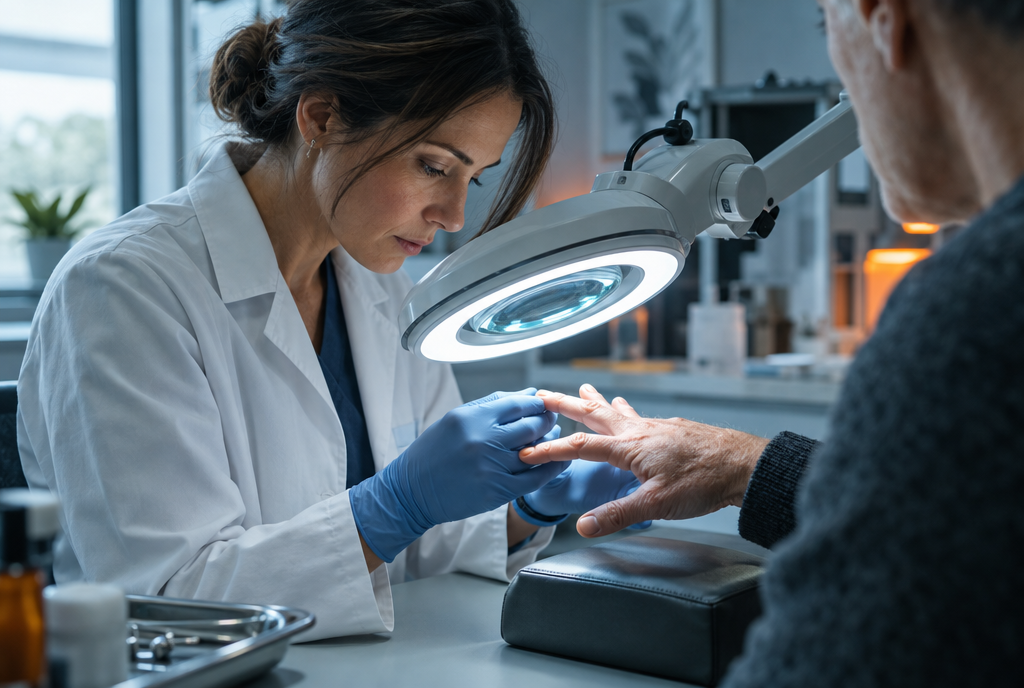
Primary Raynaud's happens on its own, usually starts in the teens or twenties, and is generally mild. Secondary Raynaud's is caused by another condition, medicine or exposure, often begins later in adulthood, and is more likely to cause finger sores. Clinicians tell them apart with a history, an exam, a look at the nailfold capillaries and blood tests such as ANA.
What is primary Raynaud's?
Primary Raynaud's, sometimes called Raynaud's disease, occurs without an underlying illness. It is by far the more common form: the Raynaud's Association estimates that about 90% of cases are primary. Mayo Clinic notes that it can be mild enough that some people never seek care, and that it sometimes goes away on its own.
It usually begins young. Mayo Clinic says primary Raynaud's often starts between ages 15 and 30, and Johns Hopkins Medicine gives a similar window of 15 to 25. Cleveland Clinic lists being female, being under 30 and having a family history among the common features.
What is secondary Raynaud's?
Secondary Raynaud's, sometimes called Raynaud's phenomenon, is driven by something else. Mayo Clinic lists scleroderma, lupus, rheumatoid arthritis, Sjogren syndrome and carpal tunnel syndrome among associated conditions, along with some medicines such as beta blockers and certain migraine drugs. The NHS adds long-term work with vibrating tools.
It tends to appear later. Mayo Clinic says symptoms usually appear around age 40, while Johns Hopkins describes onset in midlife, between ages 35 and 40. It is less common than primary Raynaud's but tends to be more serious.
How do primary and secondary Raynaud's compare?
The table summarizes typical features. Individual cases vary, and only a clinician can say which form you have.
| Feature | Primary Raynaud's | Secondary Raynaud's |
|---|---|---|
| Cause | No underlying condition found | Linked to a disease, medicine or exposure |
| How common | Most cases (about 90%) | Less common |
| Typical onset | Teens to about 30 | Around 35 to 40 or later |
| Severity | Usually mild | Often more severe |
| Finger sores or ulcers | Uncommon | More likely |
| Nailfold capillaries | Usually normal | May show abnormal vessels |
| Blood tests such as ANA | Usually normal | May show autoimmune markers |
How is Raynaud's diagnosed?
Diagnosis starts with your description of episodes: the triggers, which fingers or toes are involved, and the color changes. Photos taken during an episode are helpful, because symptoms are often gone by the time of an appointment.
Cleveland Clinic describes two tests that help separate the forms. Nailfold capillaroscopy looks at the tiny blood vessels at the base of the fingernail under a microscope; distorted or enlarged vessels can point to an underlying connective tissue disease. An antinuclear antibody (ANA) blood test checks for autoimmune disorders. The Hospital for Special Surgery notes that blood tests are helpful in distinguishing primary from secondary Raynaud's.
What should you track before your appointment?
Episodes rarely happen in the exam room, so a simple record helps your clinician decide whether further tests are needed.
When episodes happen, what set them off (cold, air conditioning, stress) and how long they last.
Which fingers or toes are involved, and whether both sides are affected equally.
Photos showing the color changes during an episode and after rewarming.
Any sores, cracks or slow-healing spots on fingertips or toes.
Other symptoms such as joint pain, rashes, muscle weakness, tight or thickened skin, or trouble swallowing.
All medicines and supplements you take, and any long-term use of vibrating tools at work.
Why does the difference matter?
For primary Raynaud's, the focus is usually on staying warm, managing stress and avoiding triggers. Secondary Raynaud's may signal a condition that needs its own care, and it carries a higher risk of complications. The Hospital for Special Surgery notes that secondary Raynaud's is more likely to be associated with finger ulcers.
Some people first labeled with primary Raynaud's later develop signs of a connective tissue disease, so it is sensible to report new symptoms rather than assume the original label still fits.
Do warmth strategies differ between the two forms?
The basics are the same. Keep the whole body warm, including the core, dress in layers, choose mittens over gloves and avoid sudden temperature swings. People with secondary Raynaud's often need to be more consistent, because episodes can be longer and skin is more vulnerable.
If you have secondary Raynaud's with skin thickening or sores, be careful with direct heat. Warm gradually, keep a fabric layer between warmers and skin, and follow the advice of your care team.
When should you get checked?
Talk to your clinician about any new Raynaud's symptoms. The NHS highlights situations that warrant a medical review.
You are over 30 and have Raynaud's symptoms for the first time.
Symptoms affect only one side of the body.
You also have joint pain, skin rashes or muscle weakness.
Symptoms are severe, getting worse or affecting daily life.
You notice sores, ulcers or color that does not return after warming.
Key takeaways
Primary Raynaud's is common, starts young and is usually mild.
Secondary Raynaud's is linked to conditions such as scleroderma and lupus, starts later and is more likely to cause sores.
Nailfold capillaroscopy and ANA blood tests help clinicians tell the two apart.
Warmth strategies are similar for both, with extra care for fragile skin in secondary Raynaud's.
First symptoms after age 30, one-sided symptoms or sores are reasons to see a clinician.
Frequently asked questions
Is Raynaud's disease the same as Raynaud's phenomenon?
The terms are often used loosely. Cleveland Clinic uses Raynaud's disease for the primary form and Raynaud's phenomenon for the secondary form, while many sources use Raynaud's phenomenon for both. What matters is whether an underlying cause is present.
Can primary Raynaud's turn into secondary Raynaud's?
A small number of people first thought to have primary Raynaud's later develop signs of a connective tissue disease. That is why new symptoms such as joint pain, rashes or finger sores should be reported.
What blood test is used for Raynaud's?
An antinuclear antibody (ANA) test is commonly used to look for autoimmune disease. Clinicians may add other blood tests depending on your symptoms.
Is secondary Raynaud's dangerous?
It can be more serious than primary Raynaud's, mainly because of skin sores and the underlying condition. Mayo Clinic notes that rare severe cases can involve skin sores or dead tissue. Early assessment and good warmth habits both help.
Can medications cause Raynaud's?
Yes. Mayo Clinic lists beta blockers and some migraine medicines among drugs linked to secondary Raynaud's. Do not stop a medicine on your own; ask your prescriber.
From HEATJAC
We design low-profile thermal garments: a heat-reflective vest and a thermal harness with pockets for warmers or cold packs. If you have reduced sensation or a health condition, check with your clinician before adding heat.
Choosing gear? Warmth that fits daily life with Raynaud's · Before you buy: a checklist for any warming garment
Related reading
Sources
Raynaud's disease: Symptoms and causes, Mayo Clinic
Raynaud's Phenomenon, Johns Hopkins Medicine
Raynaud's Syndrome, Cleveland Clinic
Raynaud's Phenomenon and Raynaud's Syndrome, Hospital for Special Surgery
Raynaud's, NHS
Frequently Asked Questions, Raynaud's Association
About HEATJAC. HEATJAC is a thermal architecture company founded by an anesthesiologist. We design patented garment systems that capture, conduct and broaden warmth across the body, and we publish this knowledge hub because the science of staying warm should be public. HEATJAC products are not medical devices and are not intended to diagnose, treat, cure or prevent any disease.