
Why dental offices feel cold, and how patients and dental teams stay comfortable
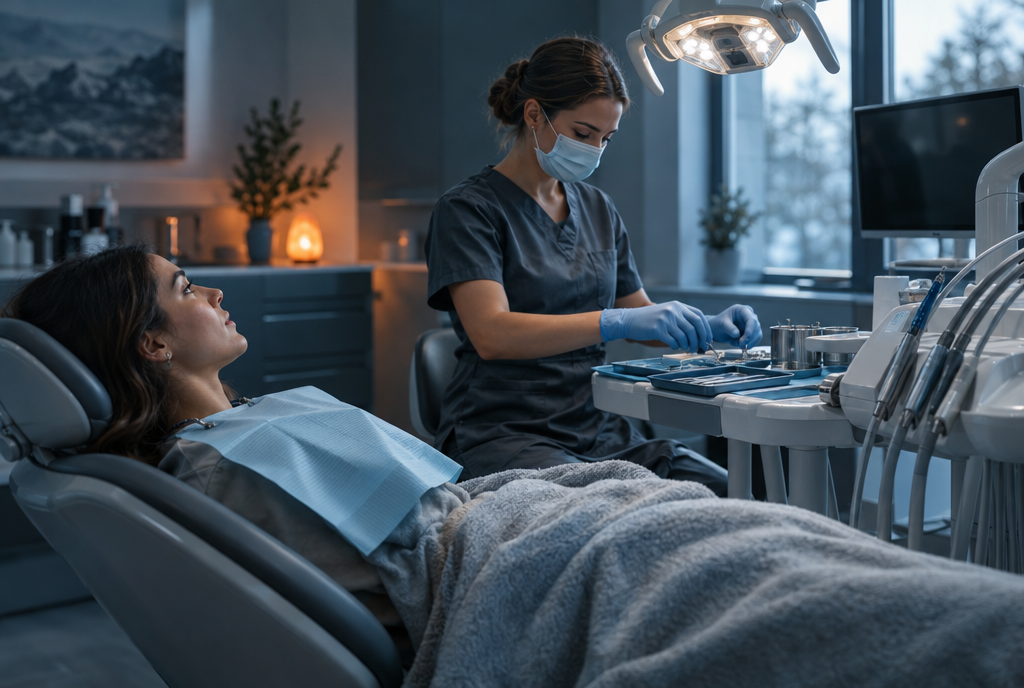
Dental offices often feel cold because the room is set for a team that is moving, standing under bright lights and wearing gowns, masks, gloves and eye protection, while the patient lies still in a reclined chair. Stillness and nervousness both cool the hands and feet. Patients can bring a layer or ask for a blanket; practices can offer blankets and set zones sensibly.
Why are dental offices so cold?
The short answer is that two groups share one small room with very different heat loads. The Dental Assisting National Board (DANB) notes that dentists, hygienists and assistants build up heat from constant movement, awkward working postures and required protective equipment such as masks, gloves and goggles. Operatory lights and equipment add warmth close to the chair.
Most thermostats end up set to keep the clinical team from overheating. DANB cites OSHA guidance of 68°F to 76°F with humidity between 20% and 60% for indoor workspaces, and notes that no universal mandate sets a single dental office temperature. Within that range, a setting that feels right to a gowned hygienist can feel chilly to a patient in a T-shirt.
Front desk staff sit more and wear less protective equipment, so they often prefer a warmer room than the clinical team. That is why one office can feel warm at reception and cold in the operatory.
Why do patients feel cold in the dental chair?
A reclined patient is almost completely still for the length of the appointment, so the body produces little extra heat. The chair usually sits under direct airflow from supply vents, and a thin bib or light clothing offers little insulation.
Nervousness plays a part as well. A study of stress and body temperature published in the journal Stress found that acute stress lowered skin temperature at the fingertips and finger bases while the torso stayed unchanged, a gradient pattern consistent with the body narrowing blood flow to the extremities. For an anxious patient, cold hands and feet can arrive before the procedure even starts.
People with Raynaud's phenomenon may notice this most. The National Institute of Arthritis and Musculoskeletal and Skin Diseases (NIAMS) lists getting cold as the most common trigger for an attack and stress as another, and advises keeping the hands, feet and entire body warm, including bringing warm clothing to air-conditioned places.
Why do dental hygienists get cold hands?
Clinicians can be warm in the body and cold in the hands at the same time. Gloves are thin, frequent hand hygiene leaves skin damp, and fine instrument work keeps the fingers relatively still. Between patients, hands move from gloves to washing to cool air several times an hour.
Cold fingers matter for precise work. A 2025 exploratory study on occupational cold stress summarized earlier research showing that manual dexterity declines at finger skin temperatures between 12°C and 20°C, with 15°C usually treated as the point of marked decline. In its own cold exposure trials, dexterity loss began at higher finger temperatures of about 23°C, and at about 26°C after rewarming. Thresholds vary by person and test, but the direction is consistent: colder fingers work less precisely.
How can patients stay warm at the dentist?
Small preparations make a real difference, and asking for comfort measures is routine. DANB lists offering blankets during appointments and suggesting patients bring suitable clothing among the ways practices keep patients comfortable.
Ask for a blanket when you sit down, before you start to feel cold.
Wear layers: a long-sleeved top plus a light sweater or zip jacket you can keep on in the chair.
Wear warm socks and closed shoes, since feet are elevated and still.
Warm your hands before the appointment with gloves on the way in or a warm drink in the waiting room, if your dentist allows it.
Tell the team if you have Raynaud's or feel cold easily, so they can adjust airflow or add a layer.
Use slow breathing or other calming strategies your dentist suggests, since stress can cool the hands.
How can dental practices keep both patients and staff comfortable?
The goal is not one perfect temperature but a setup that lets each group adjust. DANB points to zone-controlled heating and cooling, team discussion and individual adaptations such as fleece jackets, lightweight scrubs and fans.
| Who | Main reason for cold or heat | Practical measure |
|---|---|---|
| Patient in the chair | Still, reclined, under vent airflow, often anxious | Offer a blanket, invite layers, adjust vent direction |
| Hygienist or assistant | Warm body in PPE, cold damp hands | Light warm layer under the gown, warm hands on breaks |
| Dentist | Heat from PPE, lights and posture | Lighter scrubs, cooler set point in the operatory zone |
| Front desk | Seated, little PPE | Warmer zone or personal layer |
What warm layers fit dental infection-control rules?
CDC guidance for dental settings calls for long-sleeved disposable or reusable gowns or lab coats that cover skin and personal clothing likely to be soiled, and says all protective clothing should be removed before leaving the work area. In practice, that means warm layers belong under the protective gown, not over it.
A thin long-sleeved base layer or a close-fitting vest under the gown adds warmth without changing the protective outer layer. Bulky sleeves that bunch at the wrist can interfere with gloves and cuffs, so core warmth is often easier to manage than extra sleeve insulation. Check the practice's written infection-control policy before adding anything.
For hands, the best window is between patients. CDC advises hand hygiene immediately before putting on and after removing gloves, so warming the hands on a break and then performing hand hygiene before gloving keeps the sequence intact. Clinicians whose fingers change color, go numb or stay cold for a long time should talk to a clinician about those symptoms.
Key takeaways
Dental offices feel cold because the room is set for a moving, gowned team, while the patient lies still in the chair.
Stress lowers fingertip temperature, so anxious patients often feel the cold first in their hands and feet.
Earlier research places marked dexterity decline around a finger skin temperature of 15°C, which matters for fine clinical work.
Patients can ask for a blanket, wear layers and warm their hands before the visit.
Practices can use zoned temperature control, offer blankets and allow warm layers under protective gowns.
Frequently asked questions
Can I ask for a blanket at the dentist?
Yes. Many practices keep blankets for patients, and DANB lists offering blankets as a standard patient comfort measure. Ask when you sit down so you do not have to interrupt the procedure later.
What is a normal dental office temperature?
No single temperature is mandated for dental offices. DANB cites OSHA guidance of 68°F to 76°F for indoor workspaces, and practices usually set the operatory toward the cooler end for the gowned clinical team.
Why do my hands get so cold at the dentist?
Sitting still, cool air from vents and nervousness all reduce warmth in the hands. Research shows that acute stress lowers fingertip skin temperature, so warming your hands beforehand and wearing a layer can help you stay comfortable. Talk to a clinician if your fingers change color or stay numb.
I have Raynaud's. How should I prepare for a dental visit?
NIAMS advises keeping the whole body warm and bringing warm clothing to air-conditioned spaces. Wear layers and warm socks, warm your hands on the way in, and tell the dental team so they can adjust airflow or offer a blanket.
Can dental hygienists wear a jacket while treating patients?
CDC guidance calls for a protective gown or lab coat over personal clothing, removed before leaving the work area. A warm layer can usually go underneath the gown if the practice's infection-control policy allows it, but a personal jacket should not be worn over protective clothing.
From HEATJAC
We design low-profile thermal garments: a heat-reflective vest and a thermal harness with pockets for warmers or cold packs.
Choosing gear? What nurses and OR staff should look for in thermal gear · Getting a thermal vest approved for clinical areas
Related reading
Sources
What's the perfect dental office temperature?, Dental Assisting National Board (DANB)
Best Practices for Personal Protective Equipment (Dental Infection Prevention and Control), Centers for Disease Control and Prevention
Raynaud's Phenomenon, National Institute of Arthritis and Musculoskeletal and Skin Diseases (NIH)
Occupational cold stress and rewarming alters skin temperature thresholds for manual dexterity decrements: An exploratory study, PubMed Central (NIH)
The effect of stress on core and peripheral body temperature in humans, Stress (Taylor & Francis), indexed in PubMed
About HEATJAC. HEATJAC is a thermal architecture company founded by an anesthesiologist. We design patented garment systems that capture, conduct and broaden warmth across the body, and we publish this knowledge hub because the science of staying warm should be public. HEATJAC products are not medical devices and are not intended to diagnose, treat, cure or prevent any disease.