
Cold water survival time chart: the 1-10-1 rule and what charts get wrong
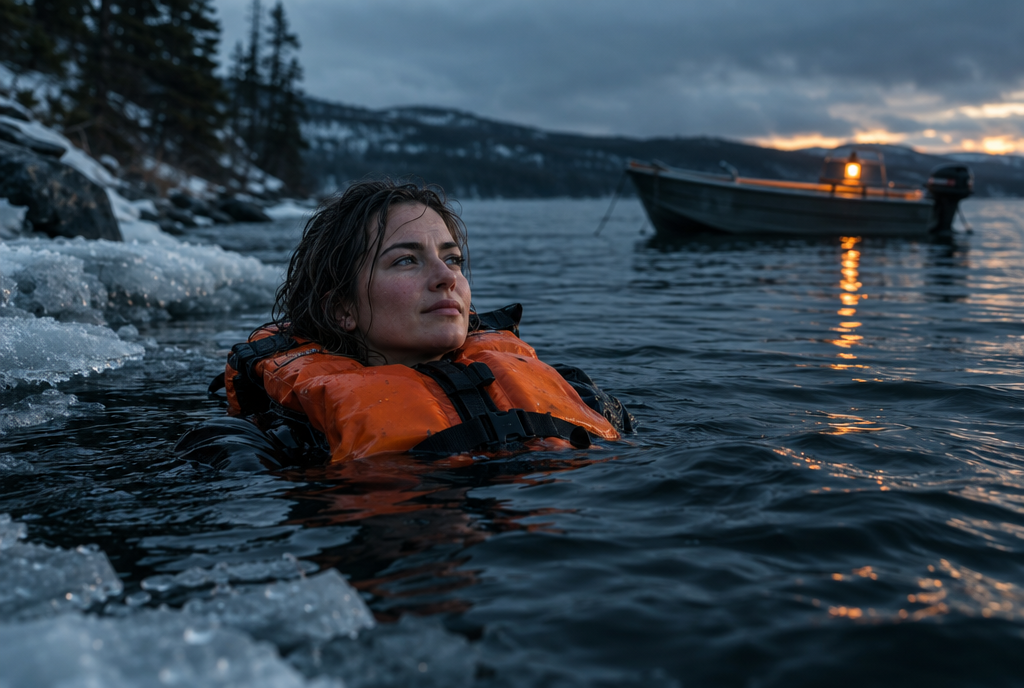
Survival time in cold water is usually decided in the first minutes, not hours. Cold shock peaks in water between 10 and 15°C (50 to 59°F) and can cause drowning within seconds, and arms can fail within minutes. Hypothermia takes at least 30 minutes to develop in adults, even in ice-cold water. Wearing a life jacket is the single biggest factor.
Cold water survival time chart
The chart below is reproduced from Minnesota Sea Grant (University of Minnesota), which adapted it from survival equations published by Hayward and colleagues in 1975 and from other cold water safety references. The second column is the time to exhaustion or unconsciousness, when a person without flotation is likely to drown. The third and fourth columns assume the person is wearing flotation.
Times vary widely with body size, body fat, clothing, waves and movement, so read every number as a rough estimate for a person who survives the first minutes, not a promise. Cold shock can cause drowning within the first minute or two in water of any of the colder temperatures listed, long before these times apply.
One oddity in the source: it lists 2 to 3 hours of likely survival with flotation for both the 32.5 to 40°F and 40 to 50°F bands. The US Search and Rescue Task Force table gives 30 to 90 minutes for 32.5 to 40°F (0 to 4°C) and 1 to 3 hours for 40 to 50°F (4 to 10°C), so read the colder band's figure with caution.
| Water temperature | Exhausted or unconscious (drowning without flotation) | Likely survival time with flotation | Maximum survival time with flotation and protective gear |
|---|---|---|---|
| 32.5°F (0.3°C) | Under 15 minutes | Under 15 to 45 minutes | 1.4 hours |
| 32.5 to 40°F (0.3 to 4.5°C) | 15 to 30 minutes | 2 to 3 hours | 1.5 to 5 hours |
| 40 to 50°F (4.5 to 10°C) | 30 to 60 minutes | 2 to 3 hours | 5 to 12 hours |
| 50 to 60°F (10 to 15.5°C) | 1 to 2 hours | 3 to 5 hours | 12 to 22 hours |
| 60 to 70°F (15.5 to 21°C) | 2 to 7 hours | 4 to 17 hours | 22 to 36 hours |
| 70 to 80°F (21 to 26.5°C) | 7 to 12 hours | More than 17 hours | 36 to 54 hours |
| Above 80°F (26.5°C) | More than 12 hours | More than 17 hours | More than 54 hours |
How long can you survive in cold water?
Most charts answer with hours, but the real answer depends on what kills you first. Cold water threatens life in stages, and the early stages are the most dangerous. In a 2017 review in Experimental Physiology, Tipton and colleagues note that even in ice-cold water, hypothermia does not become possible for at least 30 minutes in adults.
Deaths that happen before that point are drowning, driven by cold shock and loss of arm and leg function. The review cites a 1977 UK Home Office report finding that about 55 percent of open-water deaths occurred within 3 meters of a safe refuge, and that two thirds of those who died were regarded as good swimmers.
| Stage | When it happens | What happens | Main risk |
|---|---|---|---|
| Cold shock | First 3 minutes (Tipton) | Gasp reflex, rapid breathing, spike in heart rate and blood pressure | Inhaling water and drowning |
| Cold incapacitation (swim failure) | About 2 to 30 minutes (Giesbrecht, as cited by NCCWS) | Arms and hands cool, nerves and muscles slow | Unable to swim, grip or stay afloat |
| Hypothermia | At least 30 minutes in adults (Tipton) | Core temperature falls | Unconsciousness, then drowning or cardiac arrest |
| Rescue collapse | During and after rescue | Blood pressure can fall when lifted upright | Collapse after leaving the water |
What is the 1-10-1 rule, and is it accurate?
The 1-10-1 principle, created by physiologist Gordon Giesbrecht and widely taught in boating courses, says you have about 1 minute to get your breathing under control, about 10 minutes of meaningful movement, and about 1 hour before losing consciousness from hypothermia. It is a useful memory aid for the order of events.
It is not a timetable. The National Center for Cold Water Safety (NCCWS) calls it a myth because the numbers conflict with Giesbrecht's own published figures: cold shock that can kill within seconds to two minutes, and incapacitation within two to thirty minutes. NCCWS also warns that the phrase "you have" implies the gasp reflex can be controlled, when it cannot.
The safer reading of 1-10-1 is about priorities: first survive the gasp with your face out of the water, then use the short window of useful movement to get out or secure flotation.
What do cold water survival charts get wrong?
Classic survival charts trace back to Barnett's 1962 hypothermia projection. NCCWS notes that at 53°F, typical charts suggest 1 to 2 hours to exhaustion or unconsciousness and 1 to 6 hours of survival. These charts model only body cooling in calm conditions. They leave out cold shock, swim failure, waves and drowning, which is why NCCWS says they should not be used to educate the public.
The table below is one example published by the Florida Fish and Wildlife Conservation Commission. Read it as a best case for a person who survives the first minutes, not as a promise.
Hypothermia-only estimates; they ignore cold shock and swim failure
Calm water assumed; waves shorten survival
Body size, clothing and fitness change the numbers
Movement speeds heat loss, which is why swimming times are shortest
| Water temperature | Floating with life jacket | Treading water | Swimming |
|---|---|---|---|
| 70°F (21°C) | 18 hours | 13 hours | 10 hours |
| 55°F (13°C) | 3.5 hours | 3 hours | 2 hours |
| 35°F (2°C) | 1.75 hours | 1.25 hours | 0.75 hours |
Why does a life jacket matter so much in cold water?
A life jacket keeps your airway clear during the gasp reflex and keeps you afloat after your arms stop working. In 2024 the US Coast Guard verified 556 recreational boating deaths. Where cause of death was known, 76 percent of victims drowned, and of drowning victims whose life jacket use was known, 87 percent were not wearing one.
Wear it before you might need it; putting one on in the water is very hard once hands stop working. In cold water, also dress for the water temperature rather than the air, with a wetsuit or drysuit when the water is cold.
What should you do if you fall into cold water?
These steps follow the stages above. They are general guidance, not a guarantee.
Keep your face out of the water and do not swim hard during the first minutes while the gasping passes.
Use the next few minutes to get out, climb onto the boat or ice, or secure flotation; stay with a capsized boat.
If you cannot get out, keep still; with a life jacket on, hold your knees to your chest or huddle with others to slow heat loss.
Call or signal for help as early as possible; dial 911 or your local emergency number.
How should you care for someone rescued from cold water?
Call 911 or your local emergency number for anyone who has been in cold water, even if they seem fine. Tipton and colleagues describe collapse in blood pressure when a person is lifted vertically and kept upright, so lift and keep the person horizontal where possible and handle them gently.
Mayo Clinic's first aid guidance for hypothermia: move the person out of the cold, remove wet clothing, cover with dry blankets and insulate from the ground, and warm the center of the body with warm, dry compresses on the neck, chest and groin. Do not rub the limbs or use hot baths or heat lamps. Offer warm, sweet, nonalcoholic drinks only if the person is alert, and begin CPR if there are no signs of life.
Red flags: shivering that stops, confusion, slurred speech, drowsiness, shallow breathing, weak pulse or loss of consciousness.
Anyone who inhaled water or was unconscious needs assessment by a clinician, even after recovering.
Key takeaways
Cold shock and swim failure cause most cold water deaths, well before hypothermia sets in.
Hypothermia takes at least 30 minutes to develop in adults, even in ice-cold water.
Read 1-10-1 and survival charts as descriptions of order, not guaranteed time.
In 2024, 87 percent of US boating drowning victims with known life jacket use were not wearing one.
Keep a rescued person horizontal, handle them gently and call emergency services.
Frequently asked questions
How long can you survive in 50 degree water?
Charts suggest one to several hours before hypothermia becomes fatal, but that assumes you survive the first minutes. Water between 50 and 59°F is where the cold shock gasp response is strongest. Without a life jacket, drowning from cold shock or swim failure is the main danger.
What is the 1-10-1 rule?
It describes 1 minute of cold shock, about 10 minutes of meaningful movement and about 1 hour before unconsciousness from hypothermia. It is a memory aid for the order of events. The National Center for Cold Water Safety warns that the real times can be much shorter.
Is it better to swim or stay still in cold water?
Swimming speeds heat loss and cooled arms fail quickly, so if you cannot reach safety within a short distance, stay still with flotation. Staying with a capsized boat also makes you easier to find. Use the first minutes to get out of the water if you can.
What water temperature is dangerous?
Cold shock can begin in water well below body temperature, and Tipton and colleagues report it peaks in water between 10 and 15°C (50 to 59°F). Water that feels only cool on a warm day can still trigger it. Dress for the water temperature, not the air.
When should someone see a clinician after falling into cold water?
Always call emergency services after a cold water immersion with any symptoms, and have anyone who inhaled water, lost consciousness or was confused checked by a clinician. Problems can appear after rescue, so do not rely on how the person looks right away.
How long can you survive in freezing water?
Without flotation, possibly only minutes. In near-freezing water around 32.5°F (0.3°C), the Minnesota Sea Grant chart gives under 15 minutes to exhaustion or unconsciousness and under 15 to 45 minutes of likely survival even with flotation. Cold shock in the first minute or two is the most immediate danger.
How long does it take to get hypothermia in 50 degree water?
Usually at least 30 minutes. Tipton and colleagues report that even in ice-cold water, hypothermia does not become possible for at least 30 minutes in adults, and the Minnesota Sea Grant chart gives 1 to 2 hours to exhaustion or unconsciousness in 50 to 60°F (10 to 15.5°C) water. Drowning from cold shock or swim failure can happen much sooner.
How long does it take to die from hypothermia in water?
It ranges from under an hour in near-freezing water to many hours in mild water, which is why charts give wide ranges. The Minnesota Sea Grant chart, for example, lists 3 to 5 hours of likely survival with flotation in 50 to 60°F (10 to 15.5°C) water. Many cold water deaths are drownings that happen before hypothermia develops.
Why do cold water survival charts give different times?
They come from different models and assumptions. Most trace back to hypothermia projections in calm water and leave out cold shock, swim failure and waves, as the National Center for Cold Water Safety points out. Body size, clothing and whether a person wears a life jacket all change the result.
If you fall into cold water and cannot get out, what should you do?
Keep your face out of the water, let the gasping pass, then stay as still as you can with flotation. Hold your knees to your chest, or huddle with others, to slow heat loss, stay with a capsized boat, and signal for help. Swimming speeds heat loss and cooled arms fail quickly.
From HEATJAC
We design low-profile thermal garments: a heat-reflective vest and a thermal harness with pockets for warmers or cold packs.
Choosing gear? The thermal gear buying, safety and care guide · What warmth costs per shift
Related reading
Sources
Cold water immersion: kill or cure?, Experimental Physiology (Tipton MJ, Collier N, Massey H, Corbett J, Harper M), 2017
The 1-10-1 Myth, National Center for Cold Water Safety
Cold Water Survival Charts Are Misleading, National Center for Cold Water Safety
2024 Recreational Boating Statistics, US Coast Guard
Hypothermia, Florida Fish and Wildlife Conservation Commission
Hypothermia: First aid, Mayo Clinic
Hypothermia: Understanding and Prevention, Minnesota Sea Grant, University of Minnesota
Cold Water Survival, United States Search and Rescue Task Force
About HEATJAC. HEATJAC is a thermal architecture company founded by an anesthesiologist. We design patented garment systems that capture, conduct and broaden warmth across the body, and we publish this knowledge hub because the science of staying warm should be public. HEATJAC products are not medical devices and are not intended to diagnose, treat, cure or prevent any disease.