
Where to put hand warmers on your body to stay warmest
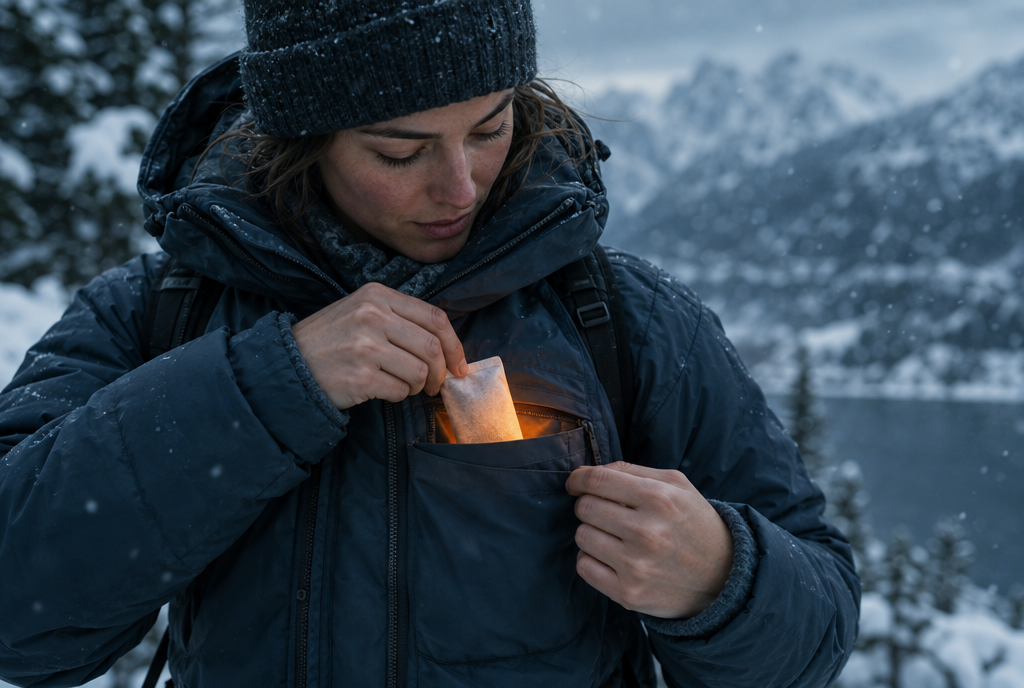
Put warmers in two places: on your core and where you feel cold. An adhesive body warmer stuck to your base layer over the upper back or chest keeps blood flowing to your hands, while hand warmers go in mittens, glove pockets or jacket pockets. In a Canadian defense research study at -13 °F (-25 °C), heating the torso kept fingers more dexterous than heating the hands directly.
Where should you put hand warmers to stay warmest?
Start with your torso. When your core cools, the body narrows blood vessels in the hands and feet to protect vital organs, so fingers and toes go cold first. Keeping the core warm gives the body permission to keep sending warm blood outward.
Researchers at a Canadian military environmental medicine institute tested this with eight men sitting in -13 °F (-25 °C) air for three hours in Arctic clothing. They compared thin gloves and mitts, electrically heated gloves, and heating the torso to raise blood flow to the hands. Torso heating was the best of the three: it kept finger comfort and dexterity, and kept the whole body, toes included, comfortable for the full three hours.
That study used heated garments rather than chemical packs, so it does not measure disposable warmers directly. The principle still applies: one warmer on the core plus one in each hand pocket usually beats two warmers in your gloves alone.
Where to put each type of warmer
Different warmers are built for different spots. Air-activated hand warmers are designed for open air and run hot; toe warmers run cooler because they sit in a tight, low-air space inside a boot. Grabber, for example, lists an average of 135 °F (57 °C) for its hand warmers and 97 °F (36 °C) for its toe warmers.
| Location | Best warmer | Why it works | Watch out for |
|---|---|---|---|
| Upper back or chest, on a base layer | Adhesive body warmer | Warms the core, which supports blood flow to hands and feet | Never stick it to skin; avoid spots under tight straps |
| Jacket or hoodie hand pockets | Hand warmer | Rewarms bare hands between tasks | Keep keys and phone in a separate pocket |
| Inside mittens | Hand warmer | Fingers share one warm space | Move it if one spot gets too hot |
| Glove pocket on the back of the hand | Hand warmer | Warms the hand while keeping the palm free to grip | A tight glove presses heat into the skin |
| Over the toes, outside the sock | Adhesive toe warmer | Designed to run cooler in a boot | Tight boots add pressure; loosen laces slightly |
| Under the foot | Insole warmer | Spreads heat under the whole foot | Use only foot-specific products in shoes |
Do hand warmers go inside gloves?
They can, but mittens work better than tight gloves. In a mitten the fingers share one warm pocket of air around the warmer. In a snug glove, the packet presses against one spot on the hand and may not reach the fingertips at all.
Many winter gloves have a zippered pocket on the back of the hand made for a warmer. That keeps your palm free to grip tools, poles or a phone. If your gloves lack one, a thin liner glove under a mitten with a warmer in the palm is a good compromise.
Keep fabric between the packet and your skin. Grabber lists a maximum of 158 °F (70 °C) for its hand warmers, well above the roughly 111 °F (44 °C) at which a review in the journal Wounds says skin burns can begin with enough contact time.
Can you put hand warmers in your shoes or socks?
It is better not to. A hand warmer is built to run hot in open air, and inside a boot it is pressed against the foot by your body weight. The Wounds review found that pressing, lying or leaning on heating devices concentrates heat into the skin and is a common pattern in contact burns.
Toe warmers are thinner, have adhesive on one side so they stay put, and are designed for the low-air space of a boot. Grabber lists a maximum of 115 °F (46 °C) for its toe warmers, far below its hand warmers. Stick the toe warmer to the outside of your sock over the toes, not to skin, and make sure the boot is not so tight that it squeezes your foot.
Where to put adhesive body warmers
Ergodyne's directions for its adhesive body warmers say to stick them to clothing and never apply them directly to skin. Good spots include a base layer or the inside of a jacket, and the larger size is meant for the chest or back.
The upper back between the shoulder blades is a popular choice because a pack is rarely pressed there unless you lean back against a seat or wear a backpack. The lower back works for standing work, but move the warmer if a belt or harness presses on it.
How to place warmers for a long day outside
Open warmers before you get cold so they reach working temperature by the time you need them.
Put one adhesive warmer on your base layer over the upper back or chest first.
Add hand warmers to mittens or pockets, and toe warmers over your socks.
Check skin under each warmer every hour or two and move any that feel hot.
Plan for run time: Grabber lists 10 hours for its hand warmers and 8 hours for its toe warmers; Ergodyne lists up to 12 hours for its body warmers.
Where not to put hand warmers
Avoid bare skin, places held under pressure, and anywhere on your body while you sleep. The Wounds review links many heating-device burns to prolonged contact during sleep, when people cannot react to heat.
Take extra care if you have numbness from diabetes, neuropathy or Raynaud's, or if you are warming a child or an older adult. Reduced sensation means skin can burn before it hurts. Keep warmers in pockets or over thick fabric, check the skin often, and ask a clinician before using them if you have reduced feeling in your hands or feet.
When to call a clinician or emergency services
Hypothermia: shivering, exhaustion, confusion, fumbling hands, memory loss, slurred speech or drowsiness. The CDC says a body temperature below 95 °F (35 °C) needs immediate medical attention; warm the center of the body first: chest, neck, head and groin.
Frostbite: redness or pain, then white or grayish-yellow skin that feels firm, waxy or numb. Get medical care, and do not use a heating pad or rub the area, because numb skin is easily burned.
Burns: blistering, broken skin or skin that stays red and painful after removing a warmer should be seen by a clinician.
Key takeaways
Warm your core first; a warm torso helps keep blood flowing to the hands and feet.
Use an adhesive body warmer on a base layer over the upper back or chest, never on skin.
Put hand warmers in mittens, glove pockets or jacket pockets; use toe warmers, not hand warmers, in boots.
Avoid pressure points, sleep and bare skin, and take extra care with numb skin.
Frequently asked questions
What is the best place to put a hand warmer?
For overall warmth, put one adhesive warmer on your base layer over the upper back or chest, then add hand warmers to mittens or pockets. Warming the core helps the body keep blood flowing to the hands.
Where do you put body warmers to stay warm?
Stick them to a base layer or the inside of a jacket over the upper back, chest or lower back. Manufacturers say not to apply them directly to skin, and avoid spots pressed by straps, belts or a seat back.
Can you put hand warmers in your bra?
It is not a good idea. A bra holds the packet tightly against skin, and pressure plus direct contact is the main burn pattern. An adhesive body warmer on an outer base layer over the chest is a safer choice.
Should toe warmers go on top of or under the toes?
Either can work as long as the warmer is stuck to the outside of the sock, not to skin. Follow your package directions, and choose an insole warmer if you want heat under the whole foot.
Can I sleep with a hand warmer in my sleeping bag?
Do not keep warmers against your body while you sleep, because you cannot react if a spot gets too hot. Warm the sleeping bag before you get in, then move the warmer away from your skin or remove it.
From HEATJAC
We design low-profile thermal garments: a heat-reflective vest and a thermal harness with pockets for warmers or cold packs.
Choosing gear? What warmth costs per shift: warmers vs battery vs heat-reflective · Heated vest vs heat-reflective vest
Related reading
Sources
Maintaining Finger Dexterity in the Cold: A Comparison of Passive, Direct and Indirect Hand Heating Methods (Brajkovic and Ducharme), Defence and Civil Institute of Environmental Medicine, NATO RTO symposium proceedings (DTIC ADP012428)
Burns Sustained From Body Heating Devices: An Integrative Review (Kornhaber et al., 2020), Wounds
Preventing Hypothermia, Centers for Disease Control and Prevention (CDC)
N-Ferno 6997 Adhesive Body Warmers, Ergodyne
Hand Warmers: product specifications, Grabber
Toe Warmers: product specifications, Grabber
About HEATJAC. HEATJAC is a thermal architecture company founded by an anesthesiologist. We design patented garment systems that capture, conduct and broaden warmth across the body, and we publish this knowledge hub because the science of staying warm should be public. HEATJAC products are not medical devices and are not intended to diagnose, treat, cure or prevent any disease.