
Toe warmers, body warmers and insoles: which warmer goes where
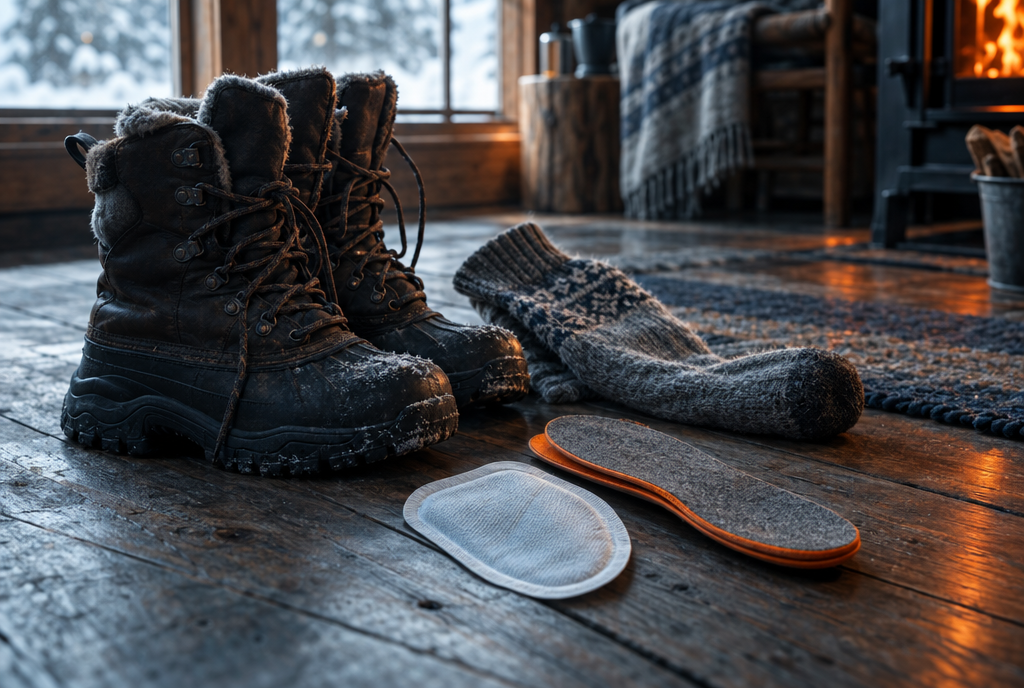
Disposable toe warmers are rated to last up to 7 to 8 hours, and stick-on body warmers up to 12 to 18 hours. Toe warmers are built to run cooler, around 102 to 113 °F (39 to 45 °C), because they sit inside a boot against the foot. Each type is shaped for one place, so match the warmer to the spot.
How do toe warmers work inside a boot?
Toe warmers use the same chemistry as air-activated hand warmers. Fine iron powder reacts with oxygen and releases heat as it rusts. A Washington State University chemistry column notes that air is about 20 percent oxygen, and the warmer keeps working only as long as oxygen reaches the powder.
A boot is a low-airflow space, so toe warmers are built for it. They are thin, they carry an adhesive back so they stay put, and they are formulated to run cooler than hand warmers. Ergodyne lists its toe and foot warmers at 102 to 113 °F (39 to 45 °C), against an average of 127 °F (53 °C) for its hand warmers.
How long do toe warmers and stick-on body warmers last?
Rated durations vary by brand. The figures below come from two makers' published specifications. Most air-activated warmers take 10 to 20 minutes to reach their working temperature after you open the pack, so open them before you need them.
Real-world time is often shorter for toe warmers. A tight boot, a thick sock over the pad or a long stretch standing still can starve the pad of air, and it cools early. A looser fit or a quick loosening of the laces often brings it back.
| Warmer type | Rated duration | Rated temperature | Where it goes |
|---|---|---|---|
| Toe warmer | Up to 7 to 8 hours | 102 to 113 °F (39 to 45 °C) | Adhesive side on the sock or insole, over or under the toes |
| Foot (insole) warmer | Up to 8 to 9 hours | 102 to 113 °F (39 to 45 °C) | Full-length pad in place of or on top of the insole |
| Hand warmer | Up to 12 hours | Average 127 °F (53 °C), max 149 °F (65 °C) | Pockets, mittens, glove pockets, never on bare skin |
| Stick-on body warmer | Up to 12 to 18 hours | Average 127 °F (53 °C), max 149 °F (65 °C) | Adhesive side on a base layer over the back or torso |
Toe warmer vs foot warmer vs insole: which should you use?
Toe warmers are small pads aimed at the toes, which are usually the first part of the foot to go cold. They add almost no bulk, so they suit snug ski, hunting and work boots.
Foot or insole warmers are full-length pads shaped like an insole. They spread milder heat under the whole foot, which suits long periods of standing on cold ground, such as ice fishing, spectating or a static work post. They take more room, so they work best in a boot with a removable liner or a half size of slack.
Hand warmers are thicker and rated hotter, so they are a poor fit inside a tight boot.
Where should you stick a toe warmer: top or bottom of the toes?
Makers direct you to stick toe warmers to the sock or insole near the toes, never to bare skin. Under the toes puts the heat where the foot meets the cold ground. Over the toes keeps the pad out from under your body weight, which reduces pressure and hot spots.
Over the top is the safer choice for walking or running. Trail Runner magazine reported a runner who developed second-degree burns on the soles of both feet after wearing toe warmers in a snowshoe race; the article advises placing them on top of the foot, and notes that one maker warns against use in ventilated shoes and during vigorous activity. Extra airflow and pressure make a warmer run hotter against the skin.
Stick the pad to a sock, not to skin, and smooth it flat so it does not fold.
Use toe warmers in insulated, closed boots, not mesh or vented athletic shoes.
Take the boot off and remove the pad if you feel any burning, stinging or a hot spot.
Where do stick-on body warmers go?
Body warmers are large adhesive pads designed to go on clothing over the torso. Ergodyne lists base layers and the inside of jackets as the intended places, and states that warming packs should never be applied directly to the skin. The lower back and the upper back between the shoulder blades are common spots because the pad lies flat there and stays in place.
Warming the core is often the most efficient use of a pad. When the torso stays warm, the body has less reason to cut blood flow to the hands and feet. Avoid placing a pad under a tight belt, harness or pack strap, where pressure can concentrate heat in one spot.
Can toe and body warmers burn you?
Yes. An integrative review of burns from body heating devices in the journal Wounds reports that skin can burn at temperatures as low as 44 °C (111 °F), and that between 44 and 51 °C (111 and 124 °F) tissue damage roughly doubles with each degree. Many hand and body warmers are rated above that range, and pressure or trapped heat raises skin temperature further.
The same review found most contact burns happened while people slept, and that people with diabetes had about four times the odds of a burn from heat therapy devices. HotHands notes that young children, people with diabetes and older adults may have reduced sensation to heat. If you have diabetes, neuropathy or poor circulation in your feet, talk to a clinician before using foot or toe warmers, and check your feet after every use.
Never place any warmer directly on skin, and never sleep with one stuck to you or tucked into socks.
Check skin every hour or so for redness, blistering or numbness.
Seek medical care for a blister, white or gray skin, and see a clinician promptly for any burn on the foot if you have diabetes.
Key takeaways
Toe warmers are rated at up to 7 to 8 hours and run cooler, about 102 to 113 °F (39 to 45 °C), than hand or body warmers.
Stick-on body warmers last longest, up to 12 to 18 hours, and go on a base layer over the back or torso.
Insole warmers spread mild heat under the whole foot; toe warmers target the toes with less bulk.
A tight boot can starve a warmer of air; a vented shoe or running can make it too hot.
Never apply a warmer to bare skin or sleep with one, and check feet closely if sensation is reduced.
Frequently asked questions
How long do toe warmers last?
Most disposable toe warmers are rated at up to 7 to 8 hours, depending on the brand. Inside a tight boot they often run out sooner because less air reaches the pad. Check the package for the exact rating.
How long do stick-on body warmers last?
Makers rate adhesive body warmers at up to 12 to 18 hours, longer than hand or toe warmers. They reach working temperature 10 to 20 minutes after opening. Stick them to a base layer, not to skin.
Can you use hand warmers as toe warmers?
It is not ideal. Hand warmers are thicker and need more air, so they often fade inside a boot, and they are rated hotter than toe warmers. Toe warmers are designed for the low-airflow space of a boot.
Why did my toe warmer stop working?
The usual cause is lack of oxygen. A tight boot, thick socks over the pad or a fully laced boot can cut airflow, and the reaction slows. Loosening the laces or briefly exposing the pad to air often restarts it if the iron is not used up.
Can toe warmers burn your feet?
Yes, especially under pressure, during running or in vented shoes, or for anyone with reduced sensation. Wear them over a sock, remove them at any hot or stinging feeling and never sleep in them. People with diabetes or neuropathy should talk to a clinician first.
Are foot warmers safe for people with diabetes?
Added heat on the feet is a known burn risk for people with diabetes because nerve damage can make heat hard to feel. Talk to your clinician before using any foot heat, and inspect your feet after use. Warm socks and insulated boots are a lower-risk first step.
From HEATJAC
We design low-profile thermal garments: a heat-reflective vest and a thermal harness with pockets for warmers or cold packs.
Choosing gear? What warmth costs per shift: warmers vs battery vs heat-reflective · Heated vest vs heat-reflective vest
Related reading
Sources
Hand Warmers: How They Work (And Everything Else You Need To Know), Ergodyne
FAQ, HotHands
Fighting Frozen Toes, Washington State University CAHNRS News
Burns Sustained From Body Heating Devices: An Integrative Review (Kornhaber et al., Wounds, 2020), Wounds / HMP Global
The Hidden Dangers of Toe Warmers, Trail Runner
About HEATJAC. HEATJAC is a thermal architecture company founded by an anesthesiologist. We design patented garment systems that capture, conduct and broaden warmth across the body, and we publish this knowledge hub because the science of staying warm should be public. HEATJAC products are not medical devices and are not intended to diagnose, treat, cure or prevent any disease.