
Reusable click hand warmers (sodium acetate): how they work
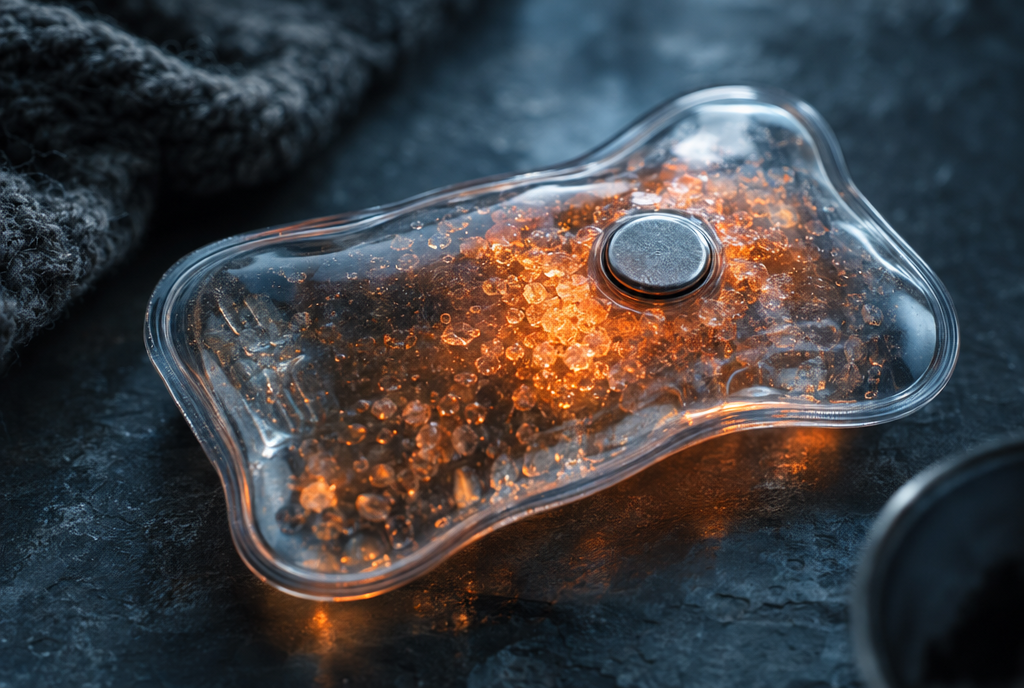
Reusable click hand warmers hold a supersaturated solution of sodium acetate in water. Flexing the small metal disc starts crystallization, and as the liquid turns solid it releases stored heat, reaching about 129 °F (54 °C). The heat lasts minutes rather than hours. Boiling the pad in water redissolves the crystals so it is ready to use again.
What is inside a reusable click hand warmer?
A click warmer is a sealed, flexible plastic pouch filled with a clear liquid and a small, thin metal disc. The liquid is sodium acetate dissolved in water. Sodium acetate is a simple salt, the same compound formed when baking soda reacts with vinegar.
There is no iron powder, no oxygen-permeable pouch and no battery. That is the key difference from disposable warmers, which heat by rusting iron in air, and from rechargeable warmers, which run a current through a heating element. A click warmer stores heat physically, as a liquid that wants to become a solid.
How does a click hand warmer work?
The trick is supersaturation. The University of Washington chemistry department describes how heating sodium acetate trihydrate above about 136 °F (58 °C) drives water out of the crystals, and the salt then dissolves in that water. Cooled carefully to room temperature, the solution holds more dissolved salt than it normally could. It is supersaturated, and it stays liquid only because nothing has given the crystals a place to start.
Clicking the disc supplies that starting point. BBC Science Focus explains that flexing the metal releases tiny metal fragments that act as seeds for crystal formation. The Royal Society of Chemistry describes the same event as the disc presenting nuclei that support crystal growth, after which needle-like crystals spread out from that spot and the contents solidify within seconds.
Crystallization is exothermic. As the dissolved salt locks back into a solid, it gives up the energy that was put in when you boiled it. In effect, the pad stores heat from your stove and releases it on demand.
How hot do reusable hand warmers get?
BBC Science Focus puts the peak at about 129 °F (54 °C). A California State University, Northridge science education demonstration measured a pad rising from about 75 °F (24 °C) to about 127 °F (53 °C) once crystallization had spread and the pad settled on a thermometer.
That is in the same range as many air-activated warmers. Chemical & Engineering News reports that iron warmers can average about 135 °F (57 °C). The difference is in shape over time: a click warmer jumps to temperature within seconds, then fades, while an iron warmer takes minutes to warm up and then holds a steadier output for hours.
How long do reusable hand warmers last?
Per use, not long. The UCL Institute of Making describes its sample pouch releasing heat for up to 30 minutes after the disc is clicked. Larger pads hold more solution and stay warm longer, and keeping the pad inside a glove or insulated pocket slows the heat loss.
Over its life, a click warmer can be reset many times. None of the sources we checked gives a fixed number of cycles, and makers' figures vary. The usual end of life is physical wear: a split seam, a leak, or a disc that no longer triggers cleanly.
| Feature | Click warmer (sodium acetate) | Disposable warmer (iron) | Rechargeable electric warmer |
|---|---|---|---|
| Heat source | Crystallization of a supersaturated salt solution | Iron oxidizing in air | Lithium-ion battery and heating element |
| Time to warm | Seconds | About 10 to 20 minutes | Varies by device and setting |
| Typical peak temperature | About 127 to 129 °F (53 to 54 °C) | About 135 °F (57 °C) average | Set by the device |
| Heat per use | Up to about 30 minutes for small pads | Several hours | Up to several hours, varies by setting |
| How to renew | Boil until clear | Not renewable | Recharge by USB |
| Main limitation | Short duration | Single use, creates waste | Battery care and cost |
How do you reset a reusable hand warmer?
Resetting means melting the crystals back into a supersaturated liquid. Follow the instructions printed on your pad, which generally follow this pattern:
Place the solid pad in a pan of water and bring it to a boil. The University of Washington notes that the salt begins dissolving above about 136 °F (58 °C) and is completely dissolved by about 174 °F (79 °C), so boiling water does the job.
Keep it in the water until the pad is completely clear, with no white crystals left. A single surviving crystal can seed the solution and trigger it again as it cools.
Lift the pad out carefully. It and the water are hot enough to scald, so use tongs and let it cool on a towel.
Let it cool undisturbed to room temperature. Avoid bending the disc during this time.
Store it flat, away from sharp objects, and keep the disc unflexed until you need heat.
Why did my reusable hand warmer go hard without clicking?
A supersaturated solution is unstable by nature, so anything that offers crystals a starting point can set it off. Common causes are a few undissolved crystals left after a short boil, the disc being bent in a bag or pocket, or a tiny crack or rough spot inside the pouch.
A pad that triggers early is not damaged. Boil it again, a little longer, until fully clear. If it keeps self-triggering, or if you see liquid on the outside, the seal or disc may be failing, and it is time to replace it.
Are reusable click warmers safe?
Used as directed, they are a simple, low-risk way to add a short burst of heat. The main hazards are burns and scalds. The pad runs hot enough that long, direct contact with skin is not advised, and the boiling step involves water hot enough to scald.
Follow the same rules as any warmer: place it in a glove, pocket or cloth sleeve rather than directly on skin, and do not sleep with it against your body. If you have diabetes, neuropathy, Raynaud's or reduced feeling in your hands, talk to your clinician before using added heat, and check your skin after use.
For many people a click warmer works best as a quick starter, for example to warm stiff fingers before a task, while clothing and insulation do the longer work of keeping your core warm.
Key takeaways
Click warmers store heat in a supersaturated sodium acetate solution and release it when crystallization starts.
Flexing the metal disc seeds the crystals; the pad reaches about 129 °F (54 °C) within seconds.
Heat lasts minutes, up to about 30 for a small pad, not the hours of an iron warmer.
Reset by boiling until every crystal dissolves, then cooling undisturbed.
Wrap the pad or place it in a pocket; do not hold it directly on skin for long periods.
Frequently asked questions
How many times can you reuse a click hand warmer?
Many times, as long as the pouch stays sealed and the disc still triggers. There is no universal number of cycles; wear on the seams and disc usually ends a pad's life. Replace it if it leaks.
Can you reset a reusable hand warmer in the microwave?
The reset method described by makers and chemistry educators is boiling in a pan of water. Follow the directions printed on your pad, and do not use a method the maker does not list.
Why is my reusable hand warmer not getting hot?
If it is already partly solid, it has crystallized and needs boiling. If it stays liquid when clicked, flex the disc firmly back and forth a few times. A pad that will not trigger after a full reset may have a worn disc.
Do click hand warmers work in very cold weather?
Yes, the crystallization still releases heat, but a cold pad loses its heat faster to the surroundings. Keep it in an inside pocket until needed and use it inside a glove or mitten.
Are click hand warmers better than disposable ones?
They are better for quick, repeatable bursts of heat and produce less waste. Disposable iron warmers are better when you need steady heat for hours. Many people carry both.
From HEATJAC
We design low-profile thermal garments: a heat-reflective vest and a thermal harness with pockets for warmers or cold packs.
Choosing gear? What warmth costs per shift: warmers vs battery vs heat-reflective · Heated vest vs heat-reflective vest
Related reading
Sources
How do re-usable hand warmers work?, BBC Science Focus
Supersaturation of Sodium Acetate, University of Washington Department of Chemistry
Hot ice, Royal Society of Chemistry, Education in Chemistry
Heat Pack: Supersaturation, California State University, Northridge, Science Education
Sodium Acetate Hand Warmers, UCL Institute of Making, Materials Library
Hand Warmers, Chemical & Engineering News (American Chemical Society)
About HEATJAC. HEATJAC is a thermal architecture company founded by an anesthesiologist. We design patented garment systems that capture, conduct and broaden warmth across the body, and we publish this knowledge hub because the science of staying warm should be public. HEATJAC products are not medical devices and are not intended to diagnose, treat, cure or prevent any disease.