
Rechargeable vs disposable hand warmers: which is better?
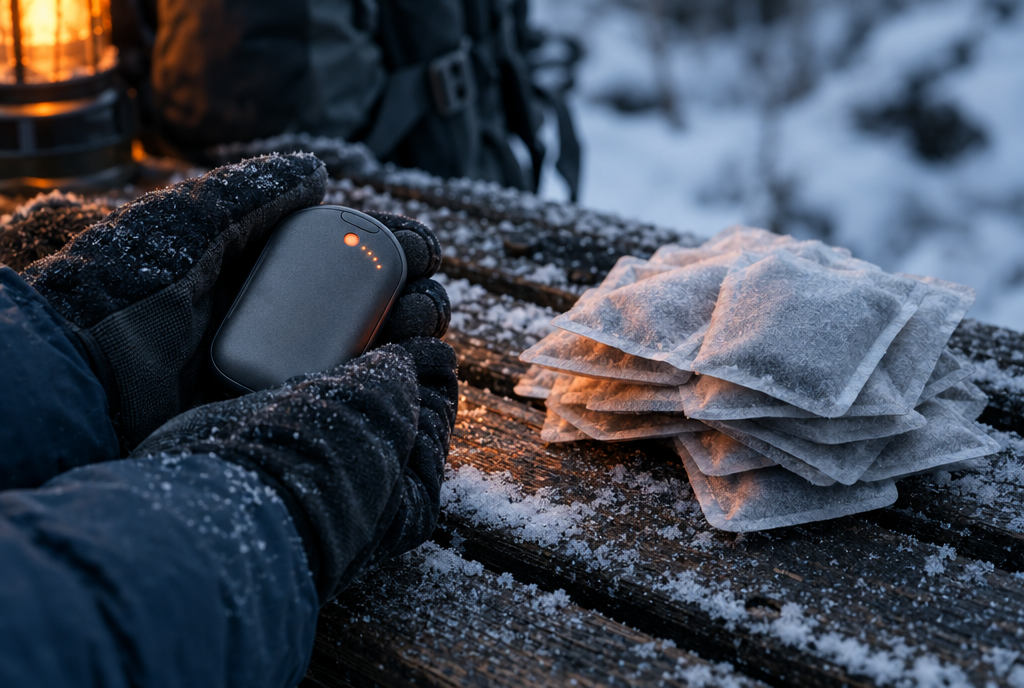
Neither wins everywhere. Disposable air-activated warmers run longer per use, often rated at up to 10 hours, need no charging and suit occasional use. Rechargeable warmers are often rated for up to about 6 hours per charge on low, offer adjustable heat and cost less over many uses, but they carry lithium-ion battery risks and follow FAA battery rules when you fly.
What is the difference between rechargeable and disposable hand warmers?
A disposable hand warmer is a sealed packet of iron powder, salt, water, activated carbon and a filler. Opening it lets air in, the iron oxidizes and the packet heats for hours until the iron is spent. It is used once and thrown away.
A rechargeable hand warmer is a small electronic device: a lithium-ion battery, a heating element and a controller with one or more heat settings. You charge it over USB, use it, and charge it again. Some also work as a small power bank for a phone.
That basic split drives every trade-off below. Chemistry gives long, steady, silent heat with no maintenance. Electronics give control and reuse, in exchange for charging, battery care and a higher upfront price.
| Factor | Disposable (air-activated) | Rechargeable (lithium-ion) |
|---|---|---|
| Heat per use | Often rated up to 10 hours for hand warmers, up to 18 for body warmers | Often rated up to about 6 hours per charge on low; less on high |
| Temperature control | None; depends on airflow | Often several heat settings |
| Warm-up time | About 10 to 20 minutes | Usually quick once switched on |
| Upfront cost | Low per pair | Higher per device |
| Cost over a season | Grows with every use | Mostly the purchase price |
| Cold-weather weak point | Low oxygen in tight boots or gloves | Battery capacity drops in deep cold |
| Main safety issue | Skin burns from direct or prolonged contact | Skin burns, plus battery overheating or fire |
| Flying | No battery; not covered by lithium rules | FAA lithium-ion device rules apply |
| Disposal | Household trash per most makers | Battery recycling or hazardous waste rules |
How long do rechargeable hand warmers last?
Runtime depends on battery size and heat setting. As one example of the category, a widely sold model with a 4,400 mAh lithium-ion battery is rated for up to 6 hours of run time, with three heat settings and a stated operating temperature up to 120 °F (49 °C). Up to usually means the lowest setting. On high, expect a fraction of that.
Cold shortens it further. Battery University notes that a battery delivering full capacity at 80 °F (27 °C) will typically deliver only about 50 percent at 0 °F (minus 18 °C), though the drop differs by chemistry. The loss is temporary and returns as the battery warms, so keeping a rechargeable warmer in an inside pocket between uses helps.
Over months and years, capacity also fades with age and charge cycles. A warmer that ran a full afternoon in its first winter may run noticeably shorter in its third.
How long do disposable hand warmers last by comparison?
Disposable warmers win on single-session runtime. HotHands lists its hand warmers at up to 10 hours, toe warmers up to 8 and body warmers up to 18, and advises allowing 10 to 20 minutes to reach working temperature. Real runtime depends on airflow: a warmer pressed flat in a tight glove gets less oxygen and runs cooler.
Disposables also have a shelf life of several years when sealed, and you can pause a partly used one in an airtight bag. Our separate pages cover both topics in detail.
Which is cheaper: rechargeable or disposable hand warmers?
It depends almost entirely on how often you use them. Disposables cost little per pair but the cost repeats every outing. A rechargeable warmer costs more up front, and each charge uses a tiny amount of electricity.
A simple way to estimate your own break-even point: divide the price of the rechargeable warmer by the price of one pair of disposables you would otherwise use. The result is the number of outings before the device pays for itself. If you use warmers a handful of days a year, disposables usually stay cheaper. If you use them most days of a cold season, rechargeables usually pull ahead. Our cost and runtime comparison works through real numbers.
Are rechargeable hand warmers safe?
Both types can burn skin, and rechargeable warmers add battery risk. On July 30, 2026, the US Consumer Product Safety Commission announced a recall of about 1.5 million rechargeable hand warmers sold online by one company. The CPSC reported 1,480 overheating reports, including 15 fires and 350 burn injuries, and one death. The agency described the hazard as a lithium-ion battery that can overheat and ignite.
That recall concerns specific products, not the whole category, but it is a reason to buy from sellers who list a model number and batch information and to check cpsc.gov for recalls before use. Stop using any warmer that swells, smells, crackles, gets unusually hot or has a damaged case, and charge it where you can see it.
Never place either type directly on skin, and do not sleep with a warmer against your body.
Do not leave a rechargeable warmer on high against one spot of skin for long periods.
Never put a lithium-ion warmer in the trash. For the recalled units, the CPSC says to skip curbside recycling and retail battery drop-off boxes and contact a household hazardous waste center.
If you have diabetes, neuropathy, Raynaud's or reduced feeling in your hands, talk to your clinician before using added heat, and check your skin after each use.
Can you bring rechargeable hand warmers on a plane?
Yes, under the FAA's lithium battery rules. A rechargeable hand warmer is a portable electronic device. The FAA allows lithium-ion batteries up to 100 Wh on passenger aircraft without airline approval, requires airline approval from 101 to 160 Wh, and forbids batteries above 160 Wh. Typical hand warmers sit far below 100 Wh: watt-hours equal milliamp-hours times nominal voltage divided by 1,000, so a 4,400 mAh cell at about 3.7 V is roughly 16 Wh.
Carry it in the cabin if you can. The FAA says devices can be checked only if completely powered off and protected from accidental activation, and devices that can generate extreme heat need the heating element or battery removed or otherwise made safe, and that spare batteries and power banks must be carried on and never checked. If your bag is gate-checked, remove spares and keep them with you. Tell crew immediately if any device overheats, swells or smokes.
Air-activated warmers contain no battery, so lithium rules do not apply. For screening of everything else, check TSA's What Can I Bring tool before you fly.
Which should you choose?
Choose disposables for occasional use, long sessions without access to power, toes and boots where a device does not fit, and backup in a car or pack. Choose rechargeables for frequent, shorter sessions such as daily commutes, dog walks or games, where adjustable heat and lower running cost matter.
Many people carry both: a rechargeable warmer for routine days and a few sealed packets for long or unpredictable ones. Either way, a warm core and good gloves do more for cold hands than any pocket heater alone.
Key takeaways
Disposable warmers give longer heat per use, often up to 10 hours, with no charging.
Rechargeable warmers are often rated up to about 6 hours per charge, and less on high or in deep cold.
Rechargeables win on cost only with frequent use; disposables win for occasional use.
Lithium-ion warmers can overheat; check cpsc.gov for recalls and stop using damaged units.
For flights, rechargeable warmers follow FAA lithium rules; keep them in carry-on.
Frequently asked questions
Are rechargeable hand warmers worth it?
They are worth it if you use warmers often, such as most days of a cold season. For a few outings a year, disposable packets usually cost less and need no charging.
Do rechargeable hand warmers get as hot as disposable ones?
They are in a similar range. HotHands states its air-activated warmers produce 100 to 180 °F (38 to 82 °C) depending on the product, while the rechargeable model cited above lists up to 120 °F (49 °C). Rechargeables let you turn the heat down, which disposables cannot.
Can I put a rechargeable hand warmer in checked luggage?
The FAA allows lithium battery devices in checked bags only if completely powered off and protected from activation, and heat-producing devices also need the heating element or battery removed or made safe. Carrying it in the cabin is the simpler choice, and spare batteries or power banks must always be carried on.
Why does my rechargeable hand warmer die so fast in the cold?
Cold temporarily reduces lithium-ion battery capacity. Keep the warmer in an inside pocket between uses, start on a lower setting, and charge it fully indoors before heading out.
Can you use rechargeable hand warmers in gloves or boots?
Most are sized for pockets and palms, not inside gloves or boots. For toes and inside gloves, thin adhesive or insole-style air-activated warmers fit better; place them on socks or clothing, never directly on skin.
From HEATJAC
We design low-profile thermal garments: a heat-reflective vest and a thermal harness with pockets for warmers or cold packs.
Choosing gear? What warmth costs per shift: warmers vs battery vs heat-reflective · Heated vest vs heat-reflective vest
Related reading
Sources
Airline Passengers and Batteries, Federal Aviation Administration (PackSafe)
Portable Electronic Devices, Containing Batteries, Federal Aviation Administration (PackSafe)
OCOOPA Direct Recalls 1.5 Million Rechargeable Hand Warmers Due to Risk of Serious Injury or Death from Fire and Burn Hazards, US Consumer Product Safety Commission
BU-502: Discharging at High and Low Temperatures, Battery University
Frequently Asked Questions, HotHands (Kobayashi)
HeatBank 6 Rechargeable Hand Warmer (product specifications), Zippo
About HEATJAC. HEATJAC is a thermal architecture company founded by an anesthesiologist. We design patented garment systems that capture, conduct and broaden warmth across the body, and we publish this knowledge hub because the science of staying warm should be public. HEATJAC products are not medical devices and are not intended to diagnose, treat, cure or prevent any disease.