
Can you reuse a disposable hand warmer?
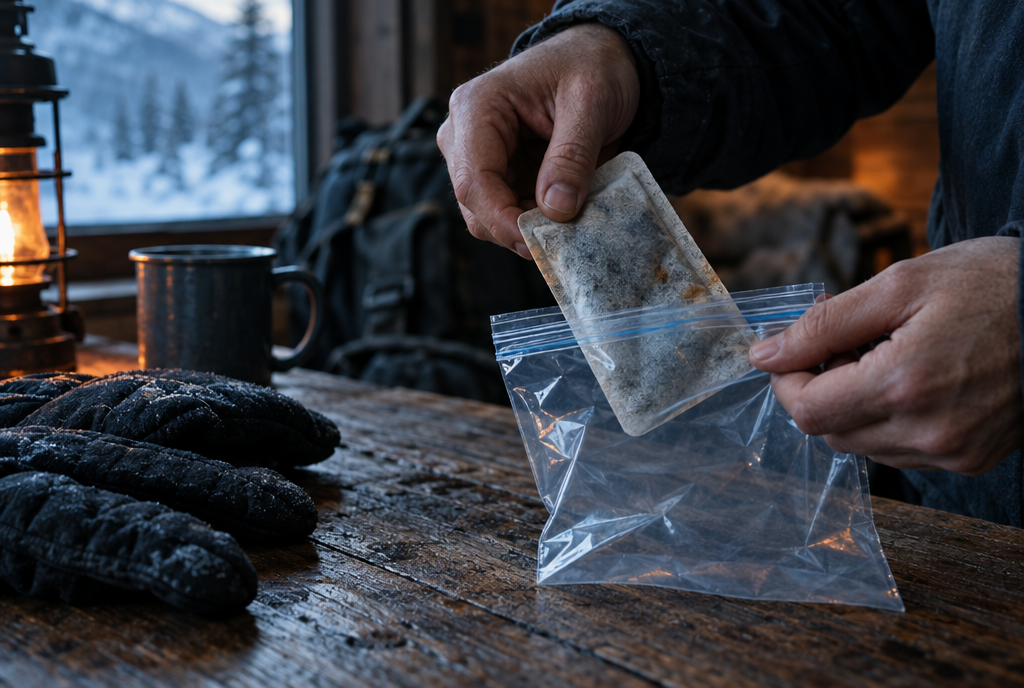
Not fully. A disposable air-activated hand warmer cannot be recharged once its iron has oxidized, but you can pause a partly used one. Seal it in an airtight zip-top or freezer bag with the air pressed out, and the reaction slows to a stop. Open the bag later and it heats again, using only the energy that was left.
Can you reuse hand warmers after opening them?
You can reuse a hand warmer in the sense of using it across two or more sessions, but you cannot restore it. The heat comes from iron powder reacting with oxygen, water and salt to form iron oxide, which is essentially rust, as Chemical & Engineering News explains. Once the iron has turned to oxide, there is nothing left to react.
That makes a disposable warmer a fixed fuel tank. The Appalachian Mountain Club's gear writer puts it plainly: there is a finite amount of potential energy in each packet. Pausing the reaction does not add heat. It only lets you spread the same heat over more hours of the day.
Ergodyne, a warmer maker, says its warmers can be reused within the 12 hours after activation but cannot be reactivated once spent. HotHands describes its warmers as designed for one-time use. Both statements fit the chemistry: pause and resume, yes; reset, no.
How do you save a hand warmer for later?
Because oxygen is a reactant, the method is simply to take the oxygen away. Ergodyne suggests sealing a warmer in a zip-top bag to put activation on hold when you only need heat for a short time.
Use a thick freezer-weight bag or a small airtight container. The Appalachian Mountain Club notes that even a small hole can let in enough oxygen to keep the reaction going.
Zip the bag almost closed, press or draw out the remaining air, then seal it quickly.
Expect the warmer to stay warm for a while after sealing, because some oxygen is trapped inside the pouch and the bag. It cools as that oxygen is used up.
Keep the bag somewhere it will not be punctured, such as an inner pocket rather than a tackle box or tool bag.
When you need heat again, open the bag, shake the warmer and give it several minutes in open air. HotHands advises allowing 10 to 20 minutes for warmers to reach working temperature.
Does the ziploc bag trick really work?
Yes, within limits. A sealed bag cuts the oxygen supply, and without oxygen the oxidation stops. It is the same reason a sealed, unopened warmer can sit on a shelf for years. The outer wrapper is a barrier that limits oxygen getting in and water getting out, according to Chemical & Engineering News.
The limits come from three places. A zip-top bag is not a perfect seal, so a slow reaction can continue and quietly use up fuel. A warmer that has dried out may restart weakly, because the absorbent filler holds the moisture the reaction needs. And each pause and restart costs some warm-up time, so the total useful heat is usually a little less than one continuous session.
A vacuum sealer or a rigid jar with a good gasket gives a tighter seal than a sandwich bag. Neither changes the total energy in the packet.
How much heat is left in a paused hand warmer?
There is no gauge, so judge by time. If a warmer is rated for about 10 hours and you used it for 4 before sealing it, the most you can expect is the remaining 6, and often somewhat less. Ratings vary by product. HotHands lists its hand warmers at up to 10 hours and body warmers at up to 18 hours, while Ergodyne lists hand and body warmers at up to 12 hours.
A paused warmer also keeps aging. If you seal a half-used warmer and find it weeks later, it may start, but it is less predictable than a fresh one. For how long sealed and expired packets last on the shelf, see our guide to how long hand warmers last.
| Situation | Can you resume it? | What to expect |
|---|---|---|
| Sealed in an airtight bag within hours of opening | Yes | Reheats within minutes; total heat is roughly what was left |
| Left open in a pocket overnight | Usually not | The reaction ran while you slept, so the iron is likely spent |
| Paused, then forgotten for weeks | Sometimes | May restart weakly if it lost moisture or the bag leaked air |
| Hard, cold and stiff after a full session | No | The iron has oxidized; dispose of it |
| Reusable gel warmer with a metal disc | Yes, many times | Reset by boiling; a different chemistry |
Can you reactivate a dead hand warmer?
No. Once the iron powder has become iron oxide, shaking it, microwaving it or adding water will not turn it back into iron. Do not microwave a used warmer. The pouch is not designed for it, and no amount of heating restores the iron.
Cutting a warmer open to give it more air is also a poor idea. The Cooper Union's materials lab notes that opening the packet intensifies the reaction, with temperatures reaching about 176 °F (80 °C), compared with an average near 104 °F (40 °C) in normal use in its demonstration. Loose powder can also make a mess of clothing.
A spent warmer is not completely useless. Ergodyne notes that used warmers can still absorb moisture, for example in a bag with a damp phone. After that, makers say they can go in household trash.
Which hand warmers are actually reusable?
If you want warmth you can reset, two other categories exist. Clear gel warmers with a small metal disc hold a supersaturated sodium acetate solution. Clicking the disc starts crystallization, which releases heat, and boiling the pad redissolves the crystals so it can be used again. They heat almost instantly but for a much shorter time than iron warmers.
Rechargeable electric warmers use a lithium-ion battery and a heating element. They last as long as the battery charge at the chosen setting and are recharged by USB. Each type has different trade-offs in runtime, cost and safety, covered in our pages on click warmers and on rechargeable versus disposable warmers.
Safety when saving and reusing warmers
A paused warmer that you reopen heats like a new one, so follow the same rules. Do not place it directly on skin, do not sleep with it against your body, and follow the package directions. Ergodyne states that warming packs should never be applied directly to the skin.
HotHands notes that young children, older adults and people with diabetes may have reduced sensation to heat. If you have diabetes, neuropathy, Raynaud's or any condition that dulls feeling in your hands or feet, ask your clinician how to use added heat safely, and check your skin after use. Keep loose warmer powder away from eyes and mouth.
Key takeaways
Disposable air-activated warmers cannot be recharged; the iron is used up as it rusts.
Sealing a partly used warmer in an airtight bag pauses the reaction so you can finish it later.
Pausing saves heat for later but never adds to the total energy in the packet.
Thick freezer bags or jars seal better than thin sandwich bags; any leak keeps the reaction going.
For true reuse, look at sodium acetate click warmers or rechargeable electric warmers.
Frequently asked questions
Can you put a hand warmer back in the package to save it?
The original wrapper is torn once opened, so it no longer seals. Use a thick zip-top freezer bag or an airtight jar instead, and press out as much air as you can.
Can you reuse a hand warmer the next day?
Often, if you sealed it in an airtight bag soon after use. It will restart after a few minutes in open air and run for roughly the time it had left. A warmer left open overnight has usually used up its iron.
Does putting a hand warmer in the freezer save it?
Cold slows the reaction, but the oxygen supply is what matters. An airtight seal is the reliable way to pause a warmer, whether or not it goes in the freezer.
Can you recharge an air-activated hand warmer in the microwave?
No. The heat comes from iron turning into iron oxide, and heating the packet does not reverse that. The pouch is not designed for a microwave, so keep it out.
How do I know when a hand warmer is completely used up?
It stays cool after shaking and several minutes in open air, and the contents often feel firm or clumped. At that point dispose of it according to the package or local guidance.
From HEATJAC
We design low-profile thermal garments: a heat-reflective vest and a thermal harness with pockets for warmers or cold packs.
Choosing gear? What warmth costs per shift: warmers vs battery vs heat-reflective · Heated vest vs heat-reflective vest
Related reading
Sources
Hand Warmers, Chemical & Engineering News (American Chemical Society)
One Simple Trick Makes Hand Warmers Last a Lot Longer, Appalachian Mountain Club
Hand Warmers and Heat Packets, The Cooper Union MetaLAB
Hand Warmers: How They Work and Everything Else You Need to Know, Ergodyne
Frequently Asked Questions, HotHands (Kobayashi)
About HEATJAC. HEATJAC is a thermal architecture company founded by an anesthesiologist. We design patented garment systems that capture, conduct and broaden warmth across the body, and we publish this knowledge hub because the science of staying warm should be public. HEATJAC products are not medical devices and are not intended to diagnose, treat, cure or prevent any disease.