
Why batteries die in the cold: phones, vapes, e-bikes and heated gear
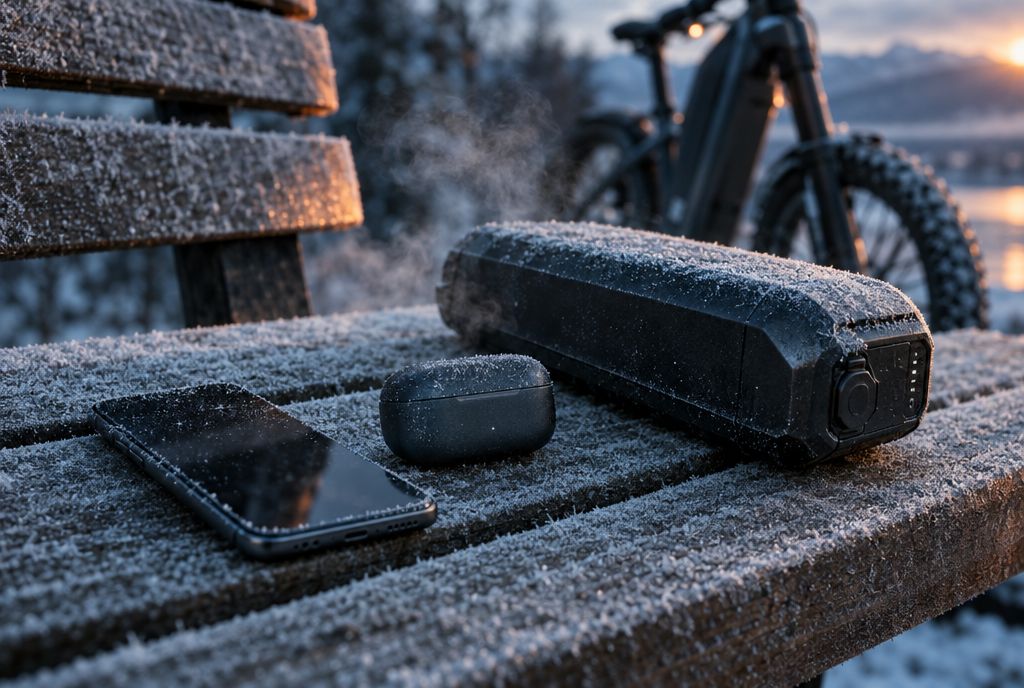
Batteries die in the cold because low temperatures slow the chemistry inside lithium-ion cells. The electrolyte thickens, internal resistance rises, and the cell cannot deliver power fast enough, so devices drain quickly or shut off. Apple and Samsung design their phones for 32 to 95 °F (0 to 35 °C). The loss is usually temporary and returns once the battery warms.
Why do lithium-ion batteries lose power in the cold?
A lithium-ion battery makes electricity by moving lithium ions through a liquid electrolyte between two electrodes. A 2025 review in RSC Advances explains that cold makes the electrolyte more viscous and slows the movement of lithium ions, which reduces usable capacity and charging and discharging efficiency.
The same review cites a drop of about 23% in state of charge when temperature fell from 77 °F (25 °C) to 5 °F (-15 °C), and charge transfer resistance three times higher at -4 °F (-20 °C) than at room temperature in one cathode type. Higher resistance means the voltage sags when a device asks for power.
Why does my device shut off when the battery still shows charge?
Apple describes this in terms of impedance, the battery's resistance to delivering current. Its support page says impedance rises temporarily in the cold and at a low state of charge, and a high-impedance battery may not supply enough power, so the phone shuts down to protect its electronics.
The charge is still there; it simply cannot get out fast enough. That is why a phone at 30% can die on a ski lift and then show 25% again after it sits in a warm pocket.
Is cold battery loss temporary or permanent?
Using a battery in the cold is mostly a temporary loss. Apple says battery life returns to normal when the device comes back to warmer temperatures, and Bosch says the performance and range of its e-bike batteries is temporarily reduced as temperature drops.
Charging in the cold is different. The RSC Advances review describes how, at low temperature, lithium can deposit as metal on the anode instead of moving into it. This lithium plating forms so-called dead lithium that cannot be used again, a permanent loss of capacity, and plating can lead to internal short circuits and thermal runaway.
Why you should not charge a battery below 32 °F (0 °C)
Most devices protect themselves. Samsung says charging may be limited when the phone is outside its safe temperature range, and Bosch recommends charging and storing e-bike batteries at room temperature in winter, particularly below 32 °F (0 °C). The FDA advises vape users not to charge devices in extreme temperatures.
The practical rule: bring a cold battery indoors and let it reach room temperature before you plug it in. If the device feels cold to the touch, wait.
Cold weather battery guidance by device type
Manufacturer ranges differ, so check the manual for your exact device. The table below summarizes what makers and regulators publish.
| Device | Published guidance | What cold does | Best practice |
|---|---|---|---|
| iPhone and iPad | Apple: use at 32 to 95 °F (0 to 35 °C); store at -4 to 113 °F (-20 to 45 °C) | Shorter battery life, possible shutdown; recovers when warm | Inside pocket; warm before charging |
| Samsung Galaxy phones | Samsung: optimal use at 32 to 95 °F (0 to 35 °C) | Unexpected shutdowns, shorter battery life; charging may be limited | Let it return to range before use |
| E-bike batteries | Bosch: charge and store at room temperature in winter; avoid storage above 86 °F (30 °C) | Temporarily lower power and range | Install just before riding; consider a thermal cover |
| Vapes and heated tobacco devices | FDA: avoid extreme temperatures; do not charge in extreme temperatures | Same lithium-ion slowdown; shorter session count | Carry close to the body; charge indoors |
| Heated clothing batteries | Check the battery label and manual | Shorter runtime at high settings | Carry a warm spare; use the lowest comfortable setting |
Why older batteries struggle more in the cold
A battery that is three or four years old often works fine indoors but fails in the cold. Apple explains that impedance rises with chemical age, which depends on charge cycles and how the battery was cared for. Cold adds its own temporary impedance on top, so an aged cell reaches the shutdown point sooner.
For scale, Apple says batteries in iPhone 14 models and earlier are designed to keep 80% of their original capacity at 500 complete charge cycles under ideal conditions, and iPhone 15 models are rated at 1,000 cycles. If an older device shuts off every cold morning, the battery may be due for replacement.
How to keep batteries working in winter
Keep phones, vapes and spare packs in an inside pocket close to your body, not in an outer shell pocket or a car overnight.
Start the day fully charged; a low state of charge and cold both raise impedance.
Carry a warm spare battery and swap it in, rather than charging a cold one.
Store loose spare cells in a case away from metal objects, as the FDA advises for vape batteries.
When you come in from the cold, give the device time to warm before charging. A sealed bag or closed case can help limit condensation on cold electronics.
Replace any battery that is swollen, damaged or wet.
Battery-heated clothing and your skin
Heated jackets, vests and gloves run on the same lithium-ion chemistry, so runtime drops in the cold. Turning the heat up to compensate raises the risk of burns where hot panels press against skin. If skin turns red, blisters or goes numb, turn the heat off and take the garment off. People with diabetes, neuropathy or other conditions that reduce sensation should talk to a clinician before relying on heated gear, and check skin often.
Key takeaways
Cold thickens the electrolyte and raises internal resistance, so lithium-ion batteries deliver less power.
Discharge loss in the cold is mostly temporary; charging a cold battery can cause permanent lithium plating.
Apple and Samsung design phones for 32 to 95 °F (0 to 35 °C).
Older batteries have higher impedance and shut down sooner in the cold.
Keep devices close to your body and warm batteries to room temperature before charging.
Frequently asked questions
Does cold weather affect heated tobacco device battery life?
Yes. Vapes and heated tobacco devices use lithium-ion batteries, which deliver less power when cold, so you may get fewer uses per charge. Keep the device in an inside pocket and charge it only after it warms indoors.
Why does an older lithium battery underperform in cold storage?
As a battery ages, its internal resistance rises. Cold raises resistance further, so an older cell hits its cutoff voltage sooner and the device shuts off. Warming it usually restores some function, but lost capacity from aging does not come back.
Is it bad to charge my phone when it is cold?
Let it warm to room temperature first. Charging a cold lithium-ion battery can plate lithium metal on the anode, which permanently reduces capacity and can raise safety risks. Many phones limit charging when they are too cold.
How cold is too cold for an e-bike battery?
Bosch recommends charging and storing its batteries at room temperature in winter, particularly below 32 °F (0 °C). Riding in the cold is fine, but expect reduced range, and keep the battery indoors until shortly before you ride.
Do batteries recover after being in the cold?
Usually, yes. Apple says battery life returns to normal when the device is back at higher temperatures. Permanent damage is more likely from charging while cold.
From HEATJAC
We design low-profile thermal garments: a heat-reflective vest and a thermal harness with pockets for warmers or cold packs.
Choosing gear? Heated vest vs heat-reflective vest · What warmth costs per shift
Related reading
Sources
If your iPhone or iPad gets too hot or too cold, Apple Support
iPhone battery and performance, Apple Support
Galaxy battery care and maintenance, Samsung US Support
Bosch batteries and chargers: product service, Bosch eBike Systems
A review of the combined effects of environmental and operational factors on lithium-ion battery performance: temperature, vibration, and charging/discharging cycles (Shi et al., 2025), RSC Advances, via PubMed Central
Tips to help avoid vape battery fires or explosions, US Food and Drug Administration
About HEATJAC. HEATJAC is a thermal architecture company founded by an anesthesiologist. We design patented garment systems that capture, conduct and broaden warmth across the body, and we publish this knowledge hub because the science of staying warm should be public. HEATJAC products are not medical devices and are not intended to diagnose, treat, cure or prevent any disease.